
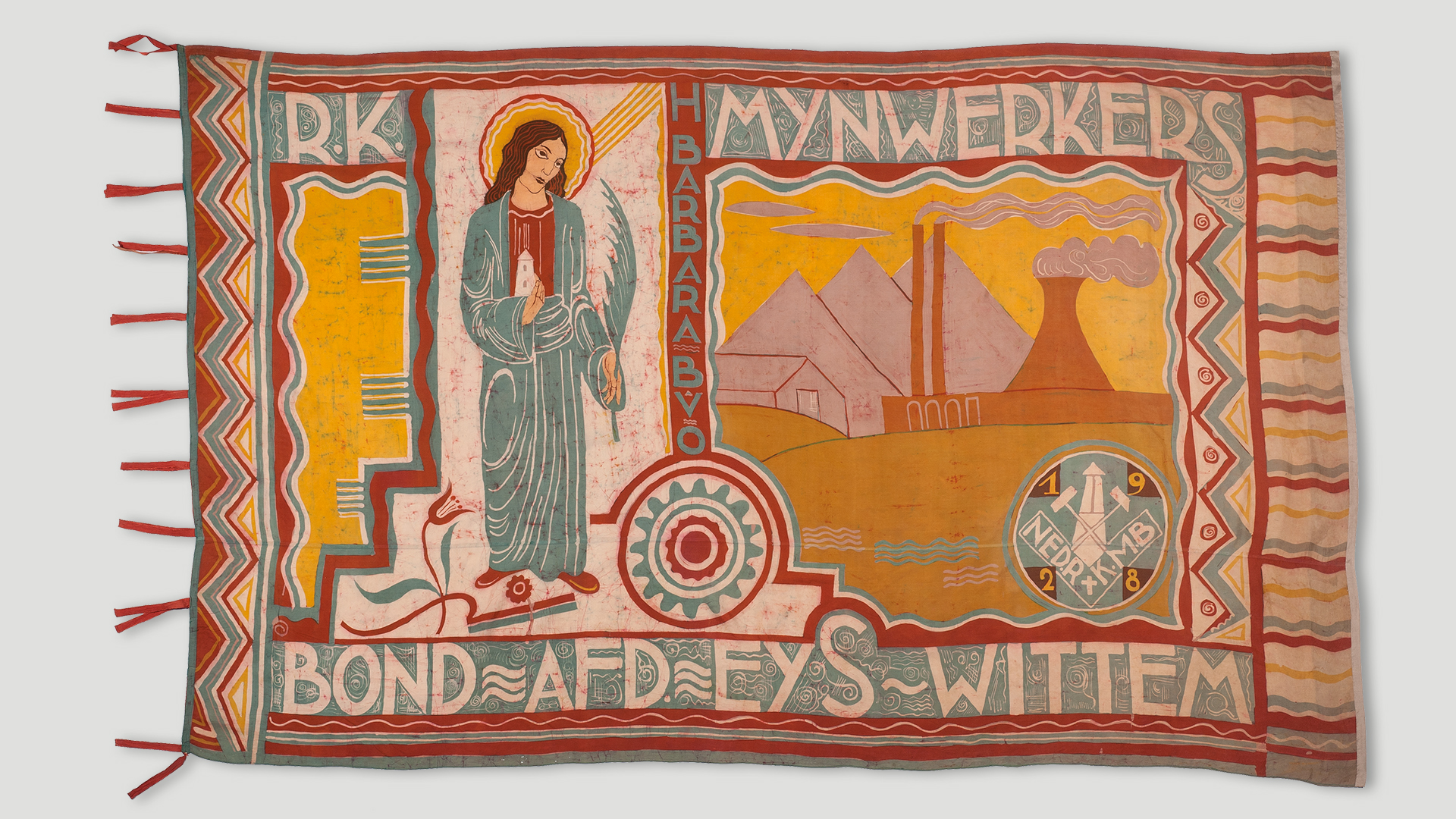
Flags and banners are more than just pieces of fabric. They show what people stand for and which community they belong to. A flag connects people who share the same beliefs, interests or goals. For members of an association, it serves as a symbol of recognition: this is who we are, this is what we stand for. At the same time, a flag also communicates with the outside world. At a glance, it reveals the values an association upholds and the place a group occupies in society. Limburg has traditionally had a rich community life. During the heyday of coal mining – from the late 19th century to the mid-20th century – churches, trade unions, music societies and sports clubs played an important social role. Almost every association had its own flag or banner. The flags in this exhibition tell stories of labour and solidarity, faith and community spirit, migration and integration. They show how people made their identity visible in public spaces. Through their shape, colour and material, they carry memories of rituals, parades and shared moments. In this way, flags are not merely historical objects, but tangible symbols of pride and solidarity.
Flags and banners give shape to identity. They make it clear which group a person belongs to and what values are associated with it. By combining symbols, colours and text, a recognisable image is created that expresses a sense of belonging. Flags played a central role in community life in the Limburg mining region. They were carried or displayed during parades, processions, events and public holidays. In public spaces, they made it clear which association was present and what its place was within the community. A flag thus functioned both internally and externally: it strengthened the sense of togetherness among members whilst simultaneously showing others who they were. Symbols such as miner’s lamps, cogwheels, figures of saints or handshakes referred to labour, faith and solidarity. By using these images, abstract values took on a concrete form. The flag thus became a recognisable symbol of solidarity and identity.
Although many flags use similar symbols, each association uses them to represent its own character. They do this through the way in which symbols are combined and designed.
The use of colour, typography, choice of materials, composition and traditional craft techniques all play an important role in this. A miner’s lamp may appear on several flags, but the way in which this symbol is used and combined says something about the association’s values and identity. In conjunction with text, religious or national symbols, the whole takes on its specific meaning and character.
This creates a shared, recognisable visual language for associations, which also allows for individuality. Because the visual language is slightly different on every flag, each flag tells its own story, whilst at the same time forming part of a larger whole.
The variation in design – from rich embroidery to simpler designs – also demonstrates how identity is expressed not only through symbols, but also through design and craftsmanship.
In a region where people from different backgrounds worked together, visual language played an important role. During the mining era, workers came to Limburg from places such as Poland and Slovenia to work in the mines. They brought their own traditions, beliefs and symbols with them. Flags and banners formed a shared visual language. Images could convey meaning without words. A miner’s lamp or cogwheel was understandable to anyone who worked underground. Religious symbols also played a unifying role. A notable example is the veneration of Saint Barbara, the patron saint of miners. This saint was originally venerated by Polish and Slovenian miners. But later she was also embraced by miners here in the region. She is therefore depicted on various flags in this exhibition. At the same time, associations continued to make their own backgrounds visible. Country-specific symbols, such as the white eagle from the Polish coat of arms, and texts in their own language expressed origin and identity.
In this way, a shared visual language could emerge within a diverse community, in which symbols both expressed a sense of connection and left room for individual cultural roots.
The meaning of a flag lies not only in its imagery. The choice of material, colour and technique also influence how a flag is perceived. At the end of the 19th and the beginning of the 20th century, expensive materials such as silk and velvet were often chosen, combined with gold or silver embroidery. These materials exuded dignity and durability. They demonstrated that an association was proud and took itself seriously. Over the course of the 20th century, the design changed. Influenced by new styles, designs became simpler and colours brighter. Materials became lighter and more practical to use. Budget and available techniques played a part in this. Designing and making a flag required craftsmanship. Workshops, monasteries and local makers worked with care on every detail. Thus, every flag tells a story not only through its imagery, but also through its fabric and stitching. Here too lie ambition, dedication and identity.
Flags and banners were not mere objects. They formed part of public and community life in the mining region. They were a visible presence at processions, anniversaries, funerals, demonstrations and commemorations. Through this repeated use, flags took on an emotional significance. They became associated with important moments and shared experiences. The fabric may have worn thin, but the meaning grew. When a flag was displayed, it became a symbol of pride and solidarity. It contributed to shared memories and strengthened the sense of togetherness. The repeated display of the same images ensured that symbols secured a permanent place in the collective memory. In this way, flags became bearers of ritual and memory. They linked the past and the present and demonstrated how identity was not only constructed, but also experienced anew time and again.